



This long post is part of an ongoing series of pieces trying to apply our taxonomy and thinking to practice in place. The concepts and language we use in these is subject to change as we do more research and thinking, but the evidence of practice holds and is of significant value to the field.
Introduction: activity, approach, and mechanism
Backbone organisations continue to be one of the most talked-about features of place-based working. The language originates in the Collective Impact framework (Kania & Kramer, 2011), and in our taxonomy of place-based mechanisms of change it sits within Category 3 (state and civil society relations) because its primary function is to coordinate relationships between state and civil society actors around a shared problem. Colleagues at Place Matters have been looking at different types of infrastructure for place based work because there is such interest in this question, and they see collective impact backbones (the subject of this piece) as just one of those infrastructure types.
Before going further, a conceptual clarification is necessary (building on our language post). In this piece, we do not see the backbone itself as a mechanism of change. It is an activity, and a well-evidenced one (as described below). The chain of effects it enacts is collective impact through collaboration: the process by which coordinated action across organisations with aligned goals produces outcomes that no single actor could achieve alone (Kania & Kramer, 2011; Hanleybrown, Kania & Kramer, 2012). This distinction matters because it gives us a more precise analytical lens. Different organisations (Right to Succeed, Thrive at Five, and others) each have their own approach to backbone working. What they share is the underlying mechanism they are trying to activate. This is not to minimise the scale of complex work required to make a backbone work (and it also enables lots of other activity) but the backbone itself doesn’t drive the whole causal chain we’re interested in.
The Collective Impact literature identifies five conditions for the mechanism to function: a common agenda, shared measurement systems, mutually reinforcing activities, continuous communication, and backbone support (Kania & Kramer, 2011). Backbone working is therefore one of five necessary components of collective impact, not a synonym for it. Evaluating backbone organisations well means asking whether all five conditions are present, not just whether a coordinating body exists.
In this piece we draw on two recent evaluations to explore how this works in practice: the Good News Report 2025 and Evaluation Report 2025 for Right to Succeed’s Cradle to Career programme in North Birkenhead (University of Manchester, 2025), and the first-year evaluation of Thrive at Five’s Stoke-on-Trent programme (Centre for Evidence and Implementation, 2024). As with all work on this Substack, our analysis is exploratory and provisional.
The funding architecture: a necessary precondition
Before examining what backbone organisations do in communities, it is essential to address something that is often understated in academic accounts of this model: the extraordinary resource mobilisation required to make it function at all.
As Graeme Duncan at Right to Succeed has put it directly: bringing together commissioning, co-commissioning, philanthropic and statutory funding to create the conditions for change is not a peripheral feature of this work, it is the enabling architecture without which the rest is impossible. It is also, in his words, the primary barrier to why more of this practice does not happen: the fundraising burden is immense, fragmented across funding streams with different timescales, accountability requirements, and decision-making processes.
This observation connects to what Toby Lowe and Dawn Plimmer (2019) describe as the challenge of financing systems change: conventional funding mechanisms are designed for linear, bounded projects, not for the relational and adaptive work of building collaborative systems. The Collective Impact literature itself identifies adequate resourcing of backbone functions as one of the most commonly cited implementation failures (Turner et al., 2012).
The model that Right to Succeed and others are working towards is one in which co-commissioning by statutory bodies, supplemented by philanthropic capital, creates both the funding base and an institutional incentive structure that rewards collaboration over competition. This is significant: it means the funding architecture is not just an operational requirement but is itself shaping the behaviour of partners.
This dimension of backbone working deserves much greater prominence in both research and policy discussions. Evaluations that focus on programme activities without accounting for the funding conditions that made them possible are likely to systematically underestimate the difficulty of replication.
The mechanism: collective impact through collaboration
The Collective Impact framework rests on a specific causal claim: that complex social problems require coordinated, multi-system responses, and that achieving this requires a dedicated infrastructure for coordination rather than relying on informal goodwill (Kania & Kramer, 2011). The mechanism can be described as a four-stage causal process:
Structural alignment: governance and accountability structures are established across partner organisations, creating a shared frame (and agenda) for action and reinforcing activities;
Relational trust-building: repeated, structured interaction builds the interpersonal and inter-organisational trust necessary for partners to move from coordination to genuine collaboration;
Shared learning: common measurement and data infrastructure enables partners to learn collectively, adapt practice, and maintain a shared understanding of progress;
System change: sustained collaboration over time begins to alter professional culture, institutional norms, and the distribution of resources, producing outcomes at population level.
The backbone role is to create and maintain the conditions in which this four-stage process can occur. This involves administrative work, but it is far more than administration. It involves data analysis and sense-making, co-design with partners and communities, brokering expertise, building the governance architecture, managing political relationships between institutions, and sustaining the attention of partners over time. To describe this as “administration” would be to significantly underestimate what is required.
Critically, the mechanism also requires a co-productive orientation, working with partners and communities rather than to them. This is not simply a values question; it is an empirical one. The literature on co-production consistently finds that interventions designed without meaningful community or partner involvement have lower implementation fidelity and are less sustainable (Loeffler & Bovaird, 2019; Needham & Carr, 2009). The backbone is most effective not when it delivers on behalf of the system, but when it creates the conditions for the system to work differently.
Two approaches to the same activity
Right to Succeed and Thrive at Five have developed different approaches to activating the mechanism of collective impact through collaboration. Both are evidence-informed; both are evolving through practice; both are national organisations with backbone teams in different locations (more than just the two looked at here). The table below identifies their shared structural features from their evaluations, alongside the specific emphases that reflect each organisation’s model and context.
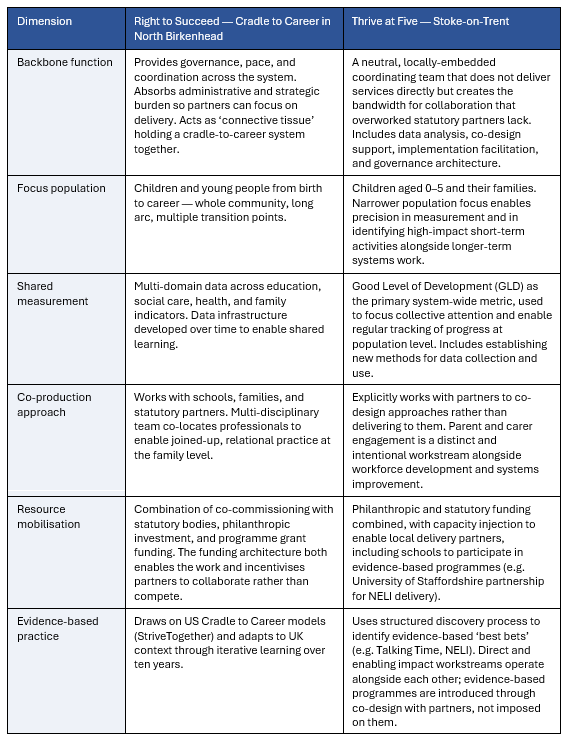
What the evidence shows
1. Structural alignment precedes relational change
Both evaluations show a similar pattern: the backbone first establishes governance and coordination structures, and this structural work creates the conditions in which relational change can follow. In North Birkenhead, the programme established a governance framework that aligned schools, statutory agencies, and community organisations within a common accountability structure. The relational trust that developed subsequently was, in part, a product of repeated, structured contact within that framework, not simply an organic outcome of co-location.
This matters analytically because it helps distinguish the work from a vaguer account of ‘relationship-building’. The evidence points to something more specific: sustained structural interaction, within a shared framework of accountability and measurement, as the precondition for the trust that enables genuine collaboration. This is consistent with the conditions identified in Huxham & Vangen’s (2005) collaborative advantage framework.
2. Professional culture change as an intermediate outcome
One of the most striking and consistent findings across both evaluations is evidence of professional culture change as an intermediate outcome of the backbone’s work. In North Birkenhead, partners described the experience as a ‘lifestyle change professionally’. In Stoke, workforce surveys showed that staff in the backbone’s operating wards felt significantly more connected and collaborative than those in other areas.
This is significant because culture change of this kind is precisely what the Collective Impact literature predicts should happen as the approach takes effect, and it is an outcome that is often difficult to evidence. The fact that both evaluations capture it, in different ways and in different contexts, strengthens the plausibility of the causal account.
From an analytical perspective, it is also worth noting that culture change of this kind is a lagging indicator. It takes time to develop and is difficult to attribute to any single intervention. The ‘nested impacts’ model described in the North Birkenhead evaluation, in which the backbone changes professional mindsets, which fosters new relationships, which creates opportunities for families, which leads to measured outcomes, is a more plausible causal account than a direct attribution claim, and the evaluations are appropriately cautious about the latter.
3. Quantitative evidence of impact
The North Birkenhead evaluation provides quantitative evidence that is, even with appropriate caution about attribution, highly significant:
A 20% reduction in re-referrals to social care;
Nearly double the rate of child protection ‘step-downs’ compared to the local authority average;
A 15-month reading gap closed across four school year groups over three years.
The Stoke evaluation that we looked at for this piece was at too early a stage to report equivalent outcomes data (the next year is out very soon). However, the GLD framework provides the shared measurement infrastructure through which such evidence is already being generated.
In the last academic year, the seven primary schools recorded an 11.4 percentage point increase in FSM-eligible children achieving a GLD (52.8% in 2024 to 64.2% in 2025)
More information can be found on the Thrive at Five website
4. The ‘invisible work’ problem
A critical finding across both evaluations is what we might call the ‘invisible work’ problem. Much of the backbone’s most important function (building trust, managing political relationships between institutions, creating the governance conditions for collaboration, sustaining the attention of busy partners) is largely unseen by those outside the process.
This invisibility has practical consequences. Partners and funders consistently underestimate the resource required to sustain backbone functions. When the backbone is effective, it is tempting to conclude that the coordination ‘runs itself’, which is precisely when the risk of under-resourcing is highest. Both evaluations identify this as a significant threat.
Sustainability: a more precise framing
An earlier version of our analysis described backbone organisations as a ‘temporary scaffold’ or a ‘prosthetic’ functioning best over a five-to-ten-year period, after which the system would operate differently without them. We have revised this framing in response to challenge from both Thrive at Five and Right to Succeed, and we think the challenge is well-founded.
The problem with the scaffold metaphor is that it implies a clean handover: the scaffold comes down, the building stands. The evidence does not support that picture. What it shows instead is something more complex:
Individual programmes and activities that the backbone has established (such as NELI in Stoke) can in many cases be sustained by the existing system, as Thrive at Five’s evaluation notes.
The backbone functions themselves (strategic coordination, governance architecture, maintaining the shared measurement infrastructure, managing political relationships between institutions) are harder to embed. They require ongoing capacity of a kind that stressed statutory systems typically do not have.
There is a real risk, documented in North Birkenhead, that a highly effective backbone creates a dependency: partners have not developed the ‘muscle’ to do the coordination themselves, because the backbone has always done it.
A more precise framing is therefore: the question is not whether the backbone should be temporary or permanent, but what needs to change in the wider system for the coordination function to be sustained without ongoing external resource. This is different for different types of backbone activity. Administrative and logistical functions may be transferable to statutory bodies. Strategic coordination and system stewardship, which require a degree of neutrality and political independence that statutory bodies often cannot provide, may require a different answer.
Thrive at Five’s framing of their own sustainability work is instructive here. They distinguish between sustainability of specific programmes (which can in many cases be achieved) and sustainability of the overall coordinating approach (which is a live question requiring explicit planning by systems leaders). Any exit from a programme of this kind is not, as they note, a cliff edge, it is a phased transition that requires deliberate design. This is consistent with the wider literature on systems change, which identifies transition planning as one of the least well-evidenced but most consequential aspects of complex social interventions (Lowe & Plimmer, 2019).
Conclusions
Drawing together what both evaluations show, our analysis suggests the following conclusions:
The mechanism of collective impact through collaboration is well-evidenced at the level of intermediate outcomes (structural alignment, professional culture change, increased collaboration) and, in the more mature programme, at the level of population outcomes (reading gaps closed, social care step-downs, improving GLD rates). The evidence is strongest for the intermediate outcomes; the attribution chain to population outcomes, while plausible and evidenced in North Birkenhead, remains difficult to establish with certainty in complex systems.
The resource mobilisation function is a necessary precondition for the mechanism to operate. It is also the primary barrier to replication. Evaluations that do not account for this are likely to be misleading about what it takes to implement these models.
The backbone’s work involves a distinctive combination of administrative, analytical, relational, and political functions. Descriptions that reduce it to administration significantly understate what is required and what is being funded.
Sustainability requires a more precise framing than the ‘temporary scaffold’ metaphor allows. The question is not whether to sustain the backbone, but which functions of the backbone can be transferred to the wider system, and which require an ongoing coordinating capacity of some kind.
The overall picture is one of models that are generating genuine learning and genuine results, working through a mechanism that is theoretically coherent and increasingly empirically supported. Thrive at Five and Right to Succeed are collectively demonstrating what it looks like to build and sustain this kind of collaborative infrastructure over time. That is both a massive service to the communities they are working in and a significant contribution to the field.
References
Centre for Evidence and Implementation (2024). Thrive at Five Stoke-on-Trent: Year 1 Evaluation Report. London: CEI.
Hanleybrown, F., Kania, J. & Kramer, M. (2012). Channeling Change: Making Collective Impact Work. Stanford Social Innovation Review.
Huxham, C. & Vangen, S. (2005). Managing to Collaborate: The Theory and Practice of Collaborative Advantage. Abingdon: Routledge.
Kania, J. & Kramer, M. (2011). Collective Impact. Stanford Social Innovation Review, Winter 2011.
Loeffler, E. & Bovaird, T. (2019). Co-commissioning of public services and outcomes in the UK: Bringing co-production into the strategic commissioning cycle. Public Money & Management, 39(4), 241–252.
Lowe, T. & Plimmer, D. (2019). Exploring the New World: Practical Insights for Funding, Commissioning and Managing in Complexity. Collaborate CIC / Basis.
Needham, C. & Carr, S. (2009). Co-production: An Emerging Evidence Base for Adult Social Care Transformation. SCIE Research Briefing 31. London: Social Care Institute for Excellence.
OECD (2020). Better Governance, Planning and Services in Local Governments through Collaboration. OECD Public Governance Policy Papers No. 4.
Turner, S., Merchant, K., Kania, J. & Martin, E. (2012). Understanding the Value of Backbone Organisations in Collective Impact. Stanford Social Innovation Review.
University of Manchester (2025). Cradle to Career North Birkenhead: Good News Report 2025 and Evaluation Report 2025. Manchester: University of Manchester.